
Fencing & Decks
Built to dry out.
New fencing and deck construction and repairs built to last in the Pacific Northwest — properly framed, cleanly finished, and designed to complement your home rather than just fill the yard.
What's included
- Cedar fence construction and replacement
- Gate installation with quality hardware
- Deck framing, decking, and railing installation
- Deck repair and board replacement
- Post setting and concrete work
- Staining, sealing, and finish work
Most fences and decks in Seattle don't wear out. They rot, and almost always at the connections: where a post meets the ground, where a flat rail holds a puddle, where a deck ledger meets the house. The boards in the middle of the fence are usually fine. A fence that should last 25 years fails in ten because of decisions made the day it was built.
Wood in our climate gets wet. That can't be avoided. The goal is wood that can dry out between rains, and nearly every choice below follows from that.
Quick answer: Crest & Level builds and repairs cedar fences, custom gates, deck framing, decking and railings for Seattle homes. Posts are kept off soil and concrete, using post-on-pipe bases or standoff hardware. Cap rails are beveled to shed water, ledgers are flashed to the house, and exterior hardware is stainless or powder-coated so it doesn't streak or fail in the rain.
Where it fails, and what I build instead
At the post base
The usual way: a wood post set straight into concrete or dirt. Water wicks into the end grain and the concrete holds it there, so the post rots from the inside out and you don't see it until the fence leans. What I build instead: wood that never touches the ground. For fences, that means post-on-pipe: a steel post is set in concrete below grade, and the cedar post sits on top of it, entirely above the soil. For deck posts, standoff bases hold the wood at least an inch above the concrete footing so air can get under it.
At the top of the fence
The usual way: a flat 2x cap that holds water after every storm. What I build instead: a beveled cap that sheds water to one side. It costs the same in material and lasts far longer.
At the gate
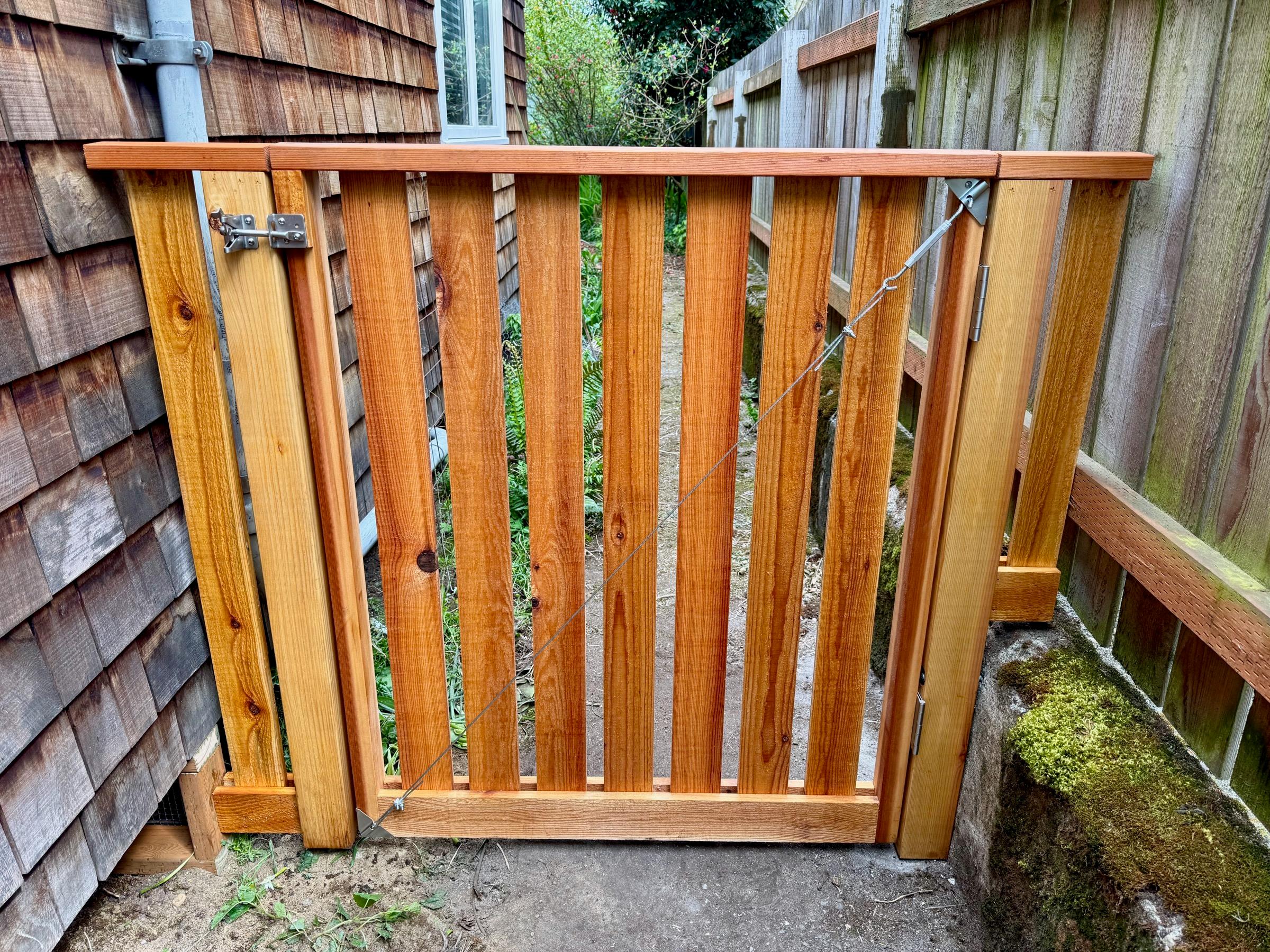
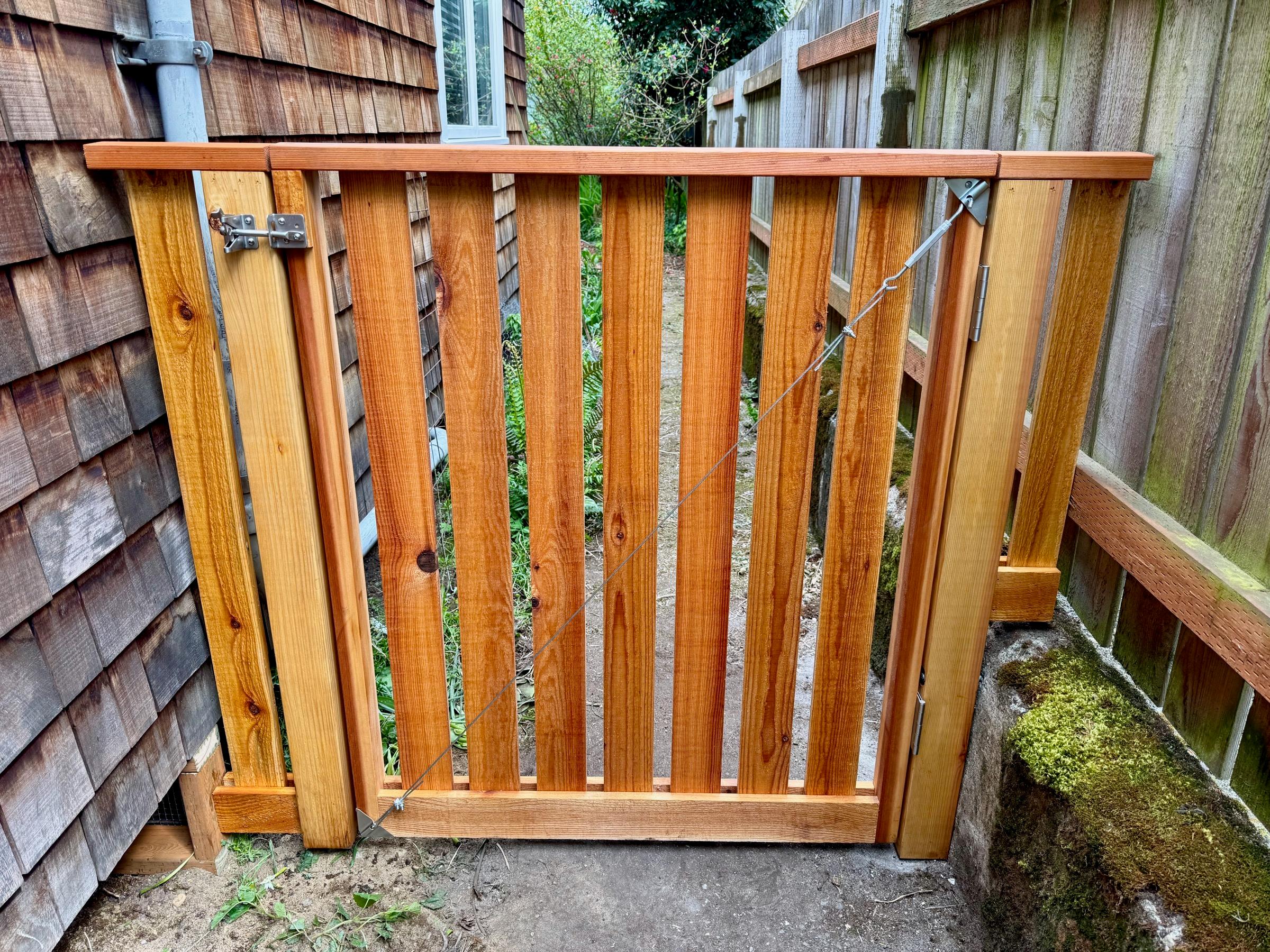
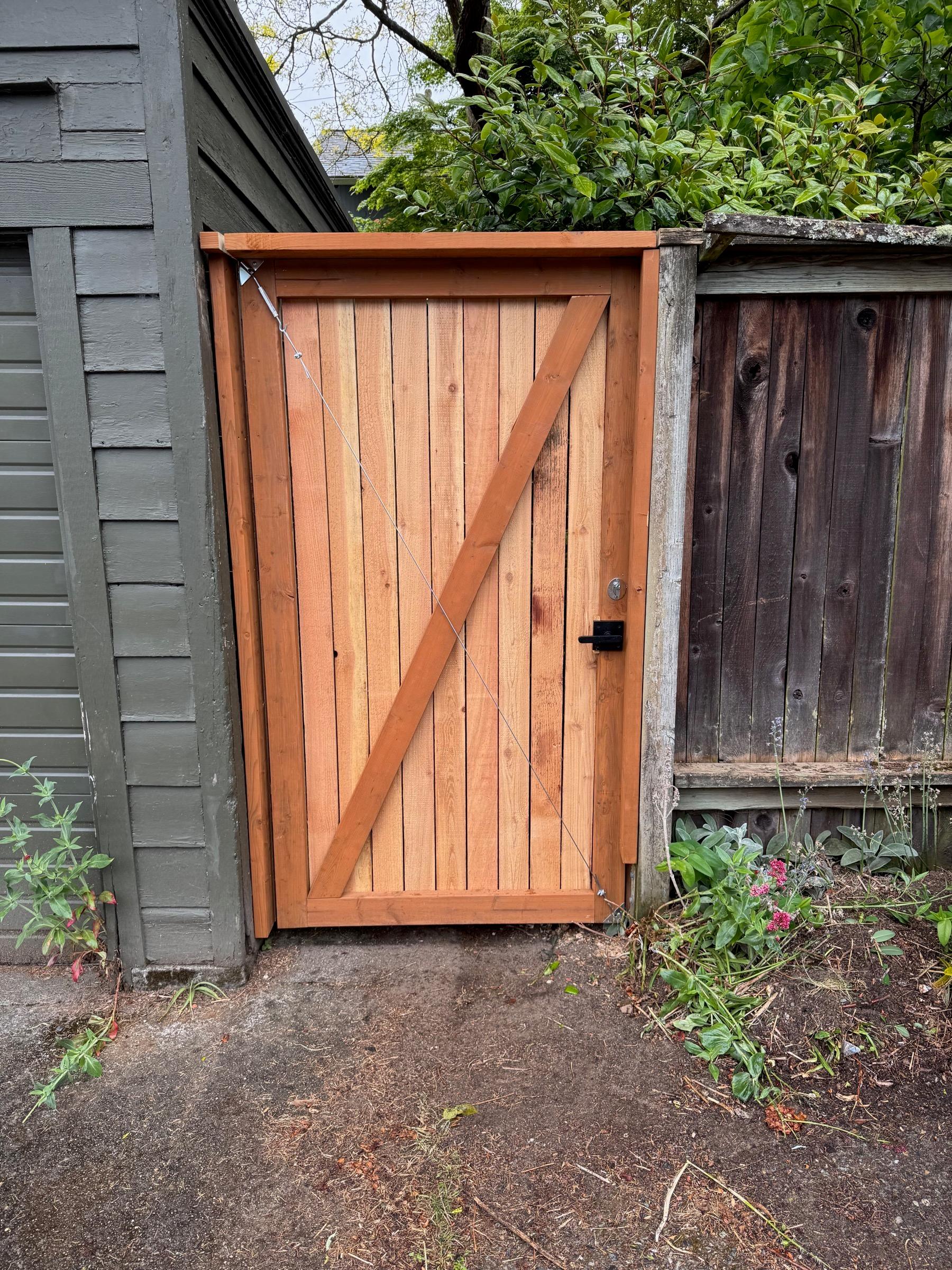
The usual way: a gate built square with no bracing, hung on light hinges with a galvanized thumb latch. Within a few seasons it sags, drags and stops latching. What I build instead: a gate framed with diagonal bracing that runs in the right direction, from the bottom of the hinge side to the top of the latch side, so it holds itself up. I add an anti-sag cable on wide gates, and use hardware rated for the weight and the weather.
At the deck ledger
The usual way: a ledger board bolted tight against the siding with no flashing. Water runs down the wall, gets trapped behind the ledger, and rots the ledger and the house rim joist together. It's the most serious rot point on an attached deck, because it's structural. What I build instead: a ledger flashed to the house with the flashing lapped under the siding or housewrap, the right fasteners into the rim joist, and a gap that lets the wall drain.
At the decking
The usual way: boards laid tight, with debris piling up in the joints, and cut ends left raw. What I build instead: consistent drainage gaps, joist tape over the tops of the framing, and end-grain sealer on every cut end before it's fastened.
The longer version, with photos, is in Why Your Fence or Deck Is Already Rotting.
Two Queen Anne jobs that show the difference
Last spring I worked on two Queen Anne homes where water had damaged fence posts early. On the first, pressure-treated posts had been set straight into poured concrete and had rotted at the base. The fix was replacing the rotted lumber and connecting new posts to the footings with concrete hardware ties, so the wood sits isolated from the concrete. On the second, a rotted cedar gate was rebuilt on cedar post-on-pipe posts, which have an integrated metal pipe for the ground contact and keep the cedar clear of the concrete and the water it holds.
On another job, an older homeowner's side-yard gate was her main entry from the alley, and its galvanized latch could be opened by anyone walking past. A long-throw keyed gate lock turned it into a gate that works like a front door: key on the outside, turn knob on the inside, no reaching over the top. That project is in Fence Gate Hardware Has Come a Long Way.
Permits and limits, by the numbers
- Fence height: In Seattle's neighborhood residential zones, fences can be 6 feet, plus up to 2 feet of open architectural features like a trellis or arbor. In a front or street-side setback, the limit is 4 feet. On sloping lots, height is averaged between posts. More detail is on the Queen Anne page.
- Deck permits: In Seattle, a deck needs a construction permit once its walking surface is more than 18 inches above the ground, which is a lower threshold than many nearby cities.
- Guards: A guard rail is required when a deck is more than 30 inches above the grade below.
- Setbacks and lot coverage: Decks taller than 18 inches can't go in some parts of your required front, side and rear yards. A deck more than 36 inches above the ground counts toward your lot coverage.
- Steep slopes: Much of Seattle's hillside property is mapped as an Environmentally Critical Area. New footings in those areas can trigger extra review. The Fremont page walks through how that works on hillside lots.
Board replacement and repairs that don't change the structure usually don't need a permit. See Do I need a permit to repair my deck in Seattle?
Finishes on a Seattle schedule
Western red cedar weathers to silver-gray on its own. If you like that look, it can be left alone, as long as the construction lets it dry. If you want to keep the color, a penetrating oil-based or hybrid semi-transparent stain on clean, dry wood works best, and it gets reapplied every few years on the weather side. Timing matters more than product. Stain goes on in our dry stretch, typically July through early September, after the wood has had several dry days, not in the first warm week of April. Cedar also reacts with plain steel and some galvanized fasteners and leaves black streaks down the boards. Stainless fasteners prevent that.
Seasonal care is covered in How should I maintain a weathered cedar fence in spring? and How do I prepare my deck for a Seattle winter?
Where the materials come from
- Dunn Lumber: cedar fence boards and posts, framing lumber, composite decking.
- Limback Lumber, Ballard: clear cedar and custom profiles for caps and gate trim.
- Tacoma Screw Products: structural fasteners, ledger screws and stainless in bulk.
- Fisheries Supply: marine-grade 316 stainless hinges and hardware for gates that live in the rain.
Some of my own cedar work starts further upstream. The arbor in my yard was milled from storm-risk trees on Camano Island. That story is in From Log to Lumber and Replacing the Cedar Arbor.
When it's bigger than us
New elevated decks, decks on steep slopes, retaining walls and anything needing engineered footings is work for a general contractor and often an engineer. If your project is heading that way, I'll tell you early and point you to people I trust, rather than stretching a repair scope over it.
What to expect
- First visit: I walk the house with you, look at the specific problem and what's around it, and tell you plainly what I'd do and what I wouldn't.
- Estimate: A written, itemized scope, including what's likely to change once a wall or floor is opened. Why I don't rely on fixed bids.
- Scheduling: I will provide an accurate plan for scheduling and completing the work.
- Cleanup: Dust containment as needed with your house left clean every day.
Fence and deck questions I hear most
Why did my fence posts rot in under ten years? Most likely they were set directly in concrete or soil, which holds water against the end grain. Posts kept above ground on post-on-pipe bases or standoff hardware can dry out between rains and last far longer.
Do I need a permit for a deck in Seattle? A construction permit is required for a deck more than 18 inches above the ground. A guard rail is required once the deck is more than 30 inches above grade. Replacing boards on an existing deck usually doesn't need a permit.
How high can my fence be in Seattle? In most neighborhood residential yards, 6 feet, plus up to 2 feet of open trellis or arbor. In a front or street-side setback, the limit is 4 feet.
Why does my gate sag? Usually the diagonal brace runs the wrong way, or there isn't one, so the gate's weight pulls the latch corner down. A brace from the bottom of the hinge side to the top of the latch side, heavier hinges and an anti-sag cable on wide gates usually fix it.
Related reading
- How long does a cedar fence last in Seattle's rain?
- How much does a custom cedar gate cost in Seattle?
- How much does deck repair cost in Seattle?
- How do I choose a cedar fence repair contractor in Queen Anne?
- How do I choose a deck restoration contractor in Ballard?
Let's look at it together
Call or text (564) 444-8388 and tell me about your fence, gate or deck, or schedule a visit.
Common questions
- How do I choose a deck restoration contractor in Ballard?
- How do I choose a cedar fence repair contractor in Queen Anne?
- How should I maintain a weathered cedar fence in spring?
- How much does a custom cedar gate cost in Seattle?
- Do I need a permit to repair my deck in Seattle?
- How long does a cedar fence last in Seattle's rain?
- How much does deck repair cost in Seattle?
- How do I prepare my deck for a Seattle winter?